Every year, preventable machinery accidents occur because workers bypass or misunderstand lockout tagout (LOTO) procedures. These incidents often stem not from faulty systems, but from poor communication, inconsistent training, and ineffective safety meetings. A well-run lockout tagout safety meeting isn’t a box-ticking exercise—it’s the frontline defense against catastrophic injury during maintenance and servicing.
If your team treats LOTO meetings as routine or repetitive, you’re already at risk. The real value comes from focused, interactive sessions that reinforce protocols, address real-world challenges, and empower employees to act confidently when isolating hazardous energy.
This guide breaks down how to conduct impactful LOTO safety meetings, from agenda design to on-the-floor application, with practical examples and proven strategies.
Why Lockout Tagout Safety Meetings Matter
Lockout tagout is more than a compliance requirement—it’s a lifesaving procedure. According to OSHA, nearly 10% of workplace fatalities in manufacturing involve uncontrolled energy release. These tragedies often occur during maintenance, cleaning, or repair when machines are unexpectedly energized.
A safety meeting centered on LOTO does three critical things:
- Reinforces muscle memory – Workers recall steps like identifying energy sources, applying locks, and verifying de-energization.
- Clarifies confusion – Employees ask about edge cases (e.g., shared equipment, shift handoffs).
- Builds accountability – Each participant becomes responsible for spotting and stopping unsafe behavior.
Without regular meetings, even trained staff can develop shortcuts. For example, one technician might bypass locking out a conveyor because “it only takes a minute,” unaware that a colleague remotely restarted it. These lapses are preventable with consistent, targeted safety discussions.
Key Elements of an Effective LOTO Safety Meeting
A high-impact meeting isn’t about duration—it’s about relevance. Focus on these components:
#### 1. Clear Objective Start with a specific goal. Instead of “review LOTO,” say: “Today, we’ll review how to handle unexpected energy reactivation during multi-shift maintenance.”
#### 2. Real Incident Review Share a near-miss or actual incident—preferably from your facility or industry. For example: > “Last month at a Midwest plant, a worker clearing a jam in a packaging machine was injured when a night-shift technician re-energized the line without checking the lockout board. The root cause? No formal handoff procedure.”
This makes the risk tangible.

#### 3. Live Demonstration Walk through a full LOTO sequence on actual equipment. Involve volunteers. Highlight common errors like: - Forgetting secondary energy sources (e.g., hydraulic pressure, springs) - Using personal locks without proper authorization - Failing to test for zero energy
#### 4. Shift Change Protocols Many LOTO failures happen during handoffs. Use the meeting to role-play shift transitions: - How do you verify locks are still in place? - Who has authority to remove a lock? - What’s documented and where?
#### 5. Q&A with Purpose Encourage questions, but guide them. Ask: - “What would you do if you found a lock with no tag?” - “How do you isolate a machine with both electrical and pneumatic sources?”
This exposes knowledge gaps.
Common Mistakes in LOTO Safety Meetings
Even experienced safety officers fall into traps that weaken effectiveness.
| Mistake | Consequence | Fix |
|---|---|---|
| One-size-fits-all agenda | Employees disengage; relevance drops | Tailor topics to recent work orders or incidents |
| No follow-up | No accountability or behavior change | Assign action items (e.g., update LOTO log, inspect tags) |
| Only theoretical discussion | Gaps in real application persist | Include hands-on drills or equipment walkthroughs |
| Dominated by management | Workers hesitate to speak up | Rotate facilitators; use anonymous question boxes |
| Infrequent scheduling | Knowledge fades | Hold meetings monthly or after system changes |
One plant manager admitted: “We used to do LOTO training once a year. Then we had a close call during a motor change. Now we meet monthly, and we’ve seen a 40% increase in reported procedural violations—because people are paying attention.”
Building a LOTO Safety Meeting Agenda
Structure is key. Use this proven 30-minute format:
- Opening (3 min) – State the purpose and relevance.
- Example: “Today’s focus: verifying zero energy on robotic arms in Cell 3.”
- Incident Spotlight (5 min) – Review a real case (internal or public).
- “A worker in Ohio lost two fingers when a robot arm cycled during calibration. The lockout was in place, but no verification test was done.”
- Step-by-Step Review (7 min) – Walk through the LOTO procedure for the relevant equipment. Call out:
- - Energy sources (electrical, hydraulic, gravity, etc.)
- - Lock application points
- - Verification method (e.g., trying to start the machine)
- Hands-On Drill (10 min) – Perform a mock LOTO. Have 2–3 employees lead it while others observe and critique.
- Q&A and Feedback (5 min) – Address concerns and document suggestions.
End with a clear takeaway: “From now on, all maintenance on robotic cells requires a second verification by a qualified person.”
LOTO Tools and Equipment You Should Review
During meetings, inspect the physical tools used. Misuse or degradation of LOTO devices undermines the entire system.
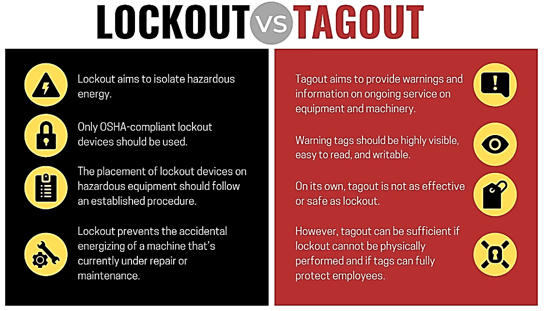
| Tool | Purpose | Common Issues |
|---|---|---|
| Lockout hasps | Allow multiple locks on one isolation point | Overloaded hasps, rust, missing hardware |
| Safety padlocks | Personal control of energy isolation | Shared keys, worn shackles |
| Tags | Communicate why equipment is locked | Illegible writing, missing dates or names |
| Valve lockouts | Prevent accidental opening of fluid lines | Incorrect size, not UV-resistant |
| Circuit breaker locks | Secure electrical disconnects | Brittle plastic, poor fit |
Bring samples to the meeting. Let employees inspect them. Ask: “Would this lock still work after six months in a humid environment?” This builds ownership and scrutiny.
Industry-Specific LOTO Meeting Challenges
Different environments demand tailored approaches.
Manufacturing: High machine density increases risk of miscommunication. Focus meetings on coordination between maintenance and operations teams. Use floor maps to show lockout zones.
Construction: Temporary setups mean evolving energy sources. Review portable equipment LOTO—like generators or compressors—that may not have standard procedures.
Healthcare: MRI machines, sterilizers, and elevators require specialized LOTO. Emphasize that “medical equipment” isn’t exempt—OSHA standards still apply.
Warehousing: Conveyor systems often span large areas. Train staff on sectional lockout—locking only the affected segment—and communication across zones.
In one distribution center, a LOTO meeting revealed that forklift technicians were using generic tags instead of equipment-specific ones. After switching, mislocks dropped by 60%.
Integrating LOTO Meetings into Your Safety Culture
A single meeting won’t change behavior. Embed LOTO into your culture with:
- Monthly cadence – Not annual or “as needed.”
- Leadership participation – When supervisors join drills, it signals priority.
- Documentation – Record attendance, topics, and action items. Review past minutes at the next meeting.
- Visual reminders – Post LOTO flowcharts near high-risk equipment.
- Recognition – Acknowledge employees who catch LOTO violations or suggest improvements.
One automotive plant introduced “LOTO Champion of the Month,” giving a badge and bonus to workers who spot or prevent unsafe practices. Reporting increased, and incidents decreased.
Action Plan: Run Your Next LOTO Meeting Effectively
You don’t need a perfect system—just a better one. Here’s how to improve your next session:
- Pick one high-risk task (e.g., die change on a press).
- Gather recent data – Maintenance logs, near-miss reports.
- Plan a 30-minute agenda using the structure above.
- Assign a co-facilitator – Rotate responsibility to boost engagement.
- End with 1 actionable rule – Example: “No maintenance without a completed LOTO checklist.”
- Follow up in 7 days – Check if the rule is being followed.
Safety isn’t created by policy alone. It’s built in moments—like a well-run LOTO meeting—where awareness becomes action.
Frequently Asked Questions
What should be covered in a lockout tagout safety meeting? Cover energy sources, step-by-step procedures, real incidents, verification methods, and shift handoffs. Tailor content to recent work or risks.
How often should LOTO safety meetings be held? At minimum, monthly. Increase frequency after incidents, new equipment, or procedure changes.
Who should attend a LOTO safety meeting? All employees involved in equipment servicing, maintenance, and operations—plus supervisors and safety officers.
Can a LOTO meeting replace formal LOTO training? No. Safety meetings reinforce training but don’t substitute for initial or periodic OSHA-mandated certification.
What’s the most common LOTO mistake in the field? Failing to verify zero energy after lockout. Workers assume isolation equals safety—never skip the test.
How do you make LOTO meetings more engaging? Use real examples, hands-on practice, anonymous questions, and employee-led segments.
Should contractors attend LOTO safety meetings? Yes. Any outside worker performing servicing must understand your LOTO procedures and participate in relevant meetings.
FAQ
What should you look for in Lockout Tagout Safety Meeting Essentials for Teams? Focus on relevance, practical value, and how well the solution matches real user intent.
Is Lockout Tagout Safety Meeting Essentials for Teams suitable for beginners? That depends on the workflow, but a clear step-by-step approach usually makes it easier to start.
How do you compare options around Lockout Tagout Safety Meeting Essentials for Teams? Compare features, trust signals, limitations, pricing, and ease of implementation.
What mistakes should you avoid? Avoid generic choices, weak validation, and decisions based only on marketing claims.
What is the next best step? Shortlist the most relevant options, validate them quickly, and refine from real-world results.